> ## Documentation Index
> Fetch the complete documentation index at: https://docs.celum.io/llms.txt
> Use this file to discover all available pages before exploring further.
# Clusters overview
> The four cluster models Celum provisions — topology clusters, GitLab-managed guest clusters, vcluster hosted control planes, and Kamaji Talos workers — and the Cluster API engine behind all of them.
Every tenant cluster in Celum lives on a [supervisor](/concepts/supervisors-and-clusters), and every supervisor runs a **Cluster API (CAPI) engine** that Celum installs and operates. On top of that one engine the platform offers four distinct cluster models — they differ in how a cluster is described, where its definition lives, and how much of a cluster you actually get.
`` and `` are placeholders throughout — substitute your own names.
## The four cluster models
| Model | What you describe | Where the definition lives |
| ----------------------------------------- | ------------------------------------------------------------------------------------------------------ | --------------------------------------------------------------------------------------------------------------------------- |
| **CAPI topology cluster** | A declarative spec: cluster class, Kubernetes version, control-plane replicas + VM size, worker groups | Applied **directly to the supervisor** via `POST /api/supervisors//capi/clusters` — no Git involved |
| **GitLab-managed guest cluster** (legacy) | Configuration files for a GitOps repository | Committed to the supervisor's attached GitLab repo (`/api/supervisors//guest-clusters`, `/api/clusters/create`) |
| **vcluster hosted control plane** | A virtual cluster whose control plane runs as pods on the supervisor, sharing its nodes | A flat `Cluster` + `VCluster` CR on the supervisor (`POST /api/supervisors//capi/vclusters`) |
| **Kamaji Talos workers** | A Talos worker pool attached to a Kamaji hosted control plane | Reconciled on demand via `POST /api/supervisors//capi/clusters//kamaji-talos-workers` |
Only the second model is GitLab-based. Topology clusters, vclusters, and Kamaji workers are applied straight to the supervisor's API — creating one commits nothing to any repository.
```mermaid theme={null}
flowchart LR
E[CAPI engine on the supervisor
providers · ClusterClasses · CRS · CAAPH] --> T[Topology clusters]
E --> G[GitLab-managed guest clusters]
E --> H[vcluster hosted CPs]
E --> M[Kamaji hosted CPs]
M --> K[Kamaji Talos workers]
```
## Topology clusters
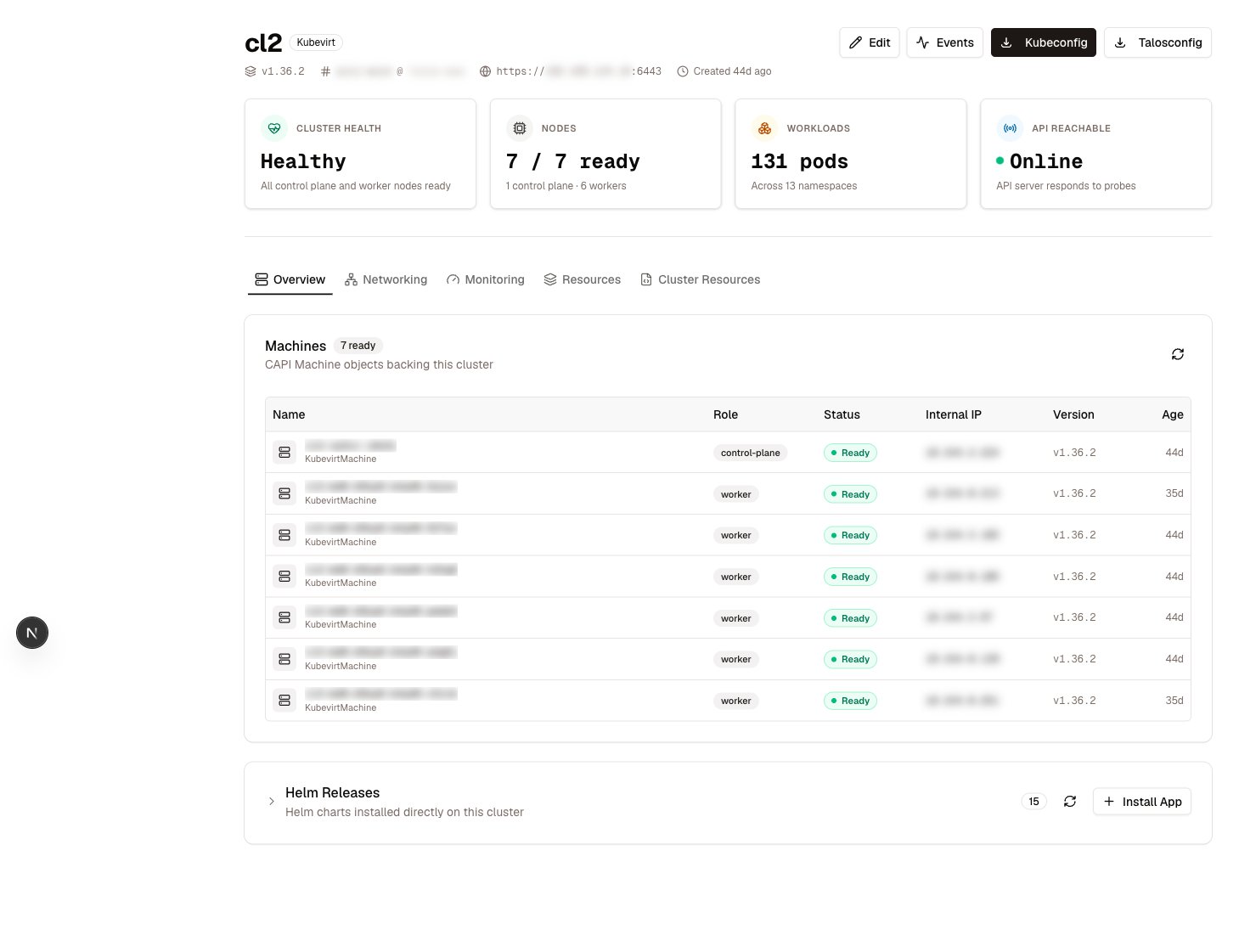
The primary model. A topology cluster is one declarative spec — Celum reads it back in the same shape for editing (`GET /api/supervisors//capi/clusters/`), updates it with `PUT`, and deletes it with a single `DELETE` that cascades through everything the `Cluster` CR owns:
```json theme={null}
{
"name": "demo-cl",
"namespace": "proj-demo",
"clusterClass": "talos-kubevirt",
"kubernetesVersion": "v1.36.2",
"controlPlaneReplicas": 1,
"controlPlaneVmSize": { "numCPUs": 2, "memoryMiB": 4096, "diskGiB": 20 },
"workerGroups": [
{ "name": "md0", "class": "default-worker", "replicas": 6,
"vmSize": { "numCPUs": 2, "memoryMiB": 4096, "diskGiB": 20 } }
],
"podsCidr": "10.246.0.0/16",
"servicesCidr": "10.113.0.0/16",
"addons": { "cniCilium": true, "platformAddons": true, "monitoring": true, "logs": true, "flows": true },
"tenantLB": { "enabled": true, "pool": "project" }
}
```
The `addons` block is what the CAAPH engine (below) acts on, and `tenantLB` wires the guest's LoadBalancer Services into the supervisor's [IP pools](/networking/pools-and-ipam). Clusters created inside a [project](/concepts/projects) land in that project's namespace.
 ## GitLab-managed guest clusters
The legacy model, still first-class where a supervisor has an attached GitOps repository: the cluster is a set of configuration files that Celum generates, previews, and commits (`POST /api/clusters/preview`, `POST /api/clusters/create`), then reconciliation on the supervisor builds the cluster. Updates and deletes are further commits (`PUT /api/supervisors//guest-clusters/`, `DELETE /api/clusters//delete`). The [create page](/clusters/create) walks through both this flow and the topology flow.
## Hosted control planes
When a tenant needs API-server isolation but not its own machines, a **vcluster** gives them a full Kubernetes control plane running as pods, sharing the supervisor's nodes. **Kamaji Talos workers** go one step further: a hosted control plane plus real Talos worker VMs attached to it. Both are covered in [Hosted control planes](/clusters/hosted-control-planes).
## The CAPI engine
Everything above depends on the engine Celum installs per supervisor during onboarding. It reports state through the standard [component-status model](/platform-health/overview) and is managed with:
| Concern | Endpoints |
| -------------------------- | -------------------------------------------------------------------------------------------------------------- |
| Install / status / recover | `POST /api/supervisors//capi/install` · `GET .../capi/status` · `POST .../capi/recover-rollback` |
| Providers | `GET /api/capi/provider-versions` (release dropdown) · `POST /api/capi/vsphere-probe` (vCenter TLS thumbprint) |
| ClusterClasses | `POST .../capi/clusterclasses/install` · `GET .../cluster-classes` |
| ClusterResourceSets | `GET .../cluster-resource-sets` · `POST .../cluster-resource-sets/install` |
| CAAPH addon engine | `POST .../capi/addons` · `GET .../capi/addons/status` |
| Version discovery | `GET .../kubernetes-versions` |
`GET /api/supervisors//capi/status` shows the operator release plus every provider — core, bootstrap, control plane (including Kamaji), and infrastructure:
```json theme={null}
{
"helmRelease": { "exists": true, "ready": true, "revision": "0.27.0" },
"coreProvider": { "exists": true, "ready": true, "installedVersion": "v1.13.2" },
"bootstrap": { "talos": { "exists": true, "ready": true, "installedVersion": "v0.7.0-alpha.2" } },
"controlPlane": {
"kamaji": { "exists": true, "ready": true, "installedVersion": "v0.20.0" },
"talos": { "exists": true, "ready": true, "installedVersion": "v0.6.0-pr251" }
},
"infrastructure": {
"kubevirt": { "exists": true, "ready": true, "installedVersion": "v0.11.2" },
"vsphere": { "exists": true, "ready": true, "installedVersion": "v1.16.1" }
}
}
```
The **CAAPH addon engine** (Cluster API Addon Provider for Helm) delivers platform charts into every guest — CNI, monitoring agents, CSI — as `HelmChartProxy` objects per namespace. Its status endpoint reports the provider and each proxy's readiness:
```json theme={null}
{
"provider": { "exists": true, "ready": true, "installedVersion": "v0.3.2" },
"helmChartProxyCRD": true,
"proxies": [
{ "name": "cilium-for-guests", "namespace": "proj-demo", "ready": true },
{ "name": "prometheus-agent-for-guests", "namespace": "proj-demo", "ready": true },
{ "name": "cluster-agent-for-guests", "namespace": "proj-demo", "ready": true }
],
"installedChartVersion": "0.6.11"
}
```
## Which model when
The default. Declarative spec, direct apply, full edit/delete lifecycle, addons delivered automatically.
Choose this when review-by-merge-request and a versioned cluster definition are requirements. Requires an attached repository.
Seconds to create, near-zero infrastructure cost, shares the supervisor's nodes. Not suitable when the tenant needs its own kernel, CNI, or node-level configuration.
The control plane runs as supervisor pods, workers are Talos VMs. Good middle ground when control-plane VMs are the cost you want to avoid.
## Permissions
| Task | Action |
| --------------------------------------------------------------------- | ----------------------------------- |
| Read engine / addon status | `capi:GetStatus` |
| Install engine, providers, ClusterClasses, addons; recover a rollback | `capi:Install` |
| Create a cluster (any model) | `cluster:Create` |
| Update / delete a cluster | `cluster:Update` / `cluster:Delete` |
| List ClusterClasses for the create form | `discovery:ListClusterClasses` |
| Install the built-in ClusterResourceSets | `supervisor:Bootstrap` |
The in-product assistant, **Celum AI**, answers cluster questions from these same APIs — `list_clusters`, `get_guest_cluster`, and `get_component_status` (component `capi` or `capi-addons`) read the identical data these pages render.
## The Clusters pages
The three creation flows — template wizard, standard form, ClusterClass form.
Reusable blueprints with Go-template variables, and CRS addons pushed into guests.
Everything read inside a running tenant — nodes, events, metrics, Helm, workloads.
vcluster instances and Kamaji Talos workers.
## GitLab-managed guest clusters
The legacy model, still first-class where a supervisor has an attached GitOps repository: the cluster is a set of configuration files that Celum generates, previews, and commits (`POST /api/clusters/preview`, `POST /api/clusters/create`), then reconciliation on the supervisor builds the cluster. Updates and deletes are further commits (`PUT /api/supervisors//guest-clusters/`, `DELETE /api/clusters//delete`). The [create page](/clusters/create) walks through both this flow and the topology flow.
## Hosted control planes
When a tenant needs API-server isolation but not its own machines, a **vcluster** gives them a full Kubernetes control plane running as pods, sharing the supervisor's nodes. **Kamaji Talos workers** go one step further: a hosted control plane plus real Talos worker VMs attached to it. Both are covered in [Hosted control planes](/clusters/hosted-control-planes).
## The CAPI engine
Everything above depends on the engine Celum installs per supervisor during onboarding. It reports state through the standard [component-status model](/platform-health/overview) and is managed with:
| Concern | Endpoints |
| -------------------------- | -------------------------------------------------------------------------------------------------------------- |
| Install / status / recover | `POST /api/supervisors//capi/install` · `GET .../capi/status` · `POST .../capi/recover-rollback` |
| Providers | `GET /api/capi/provider-versions` (release dropdown) · `POST /api/capi/vsphere-probe` (vCenter TLS thumbprint) |
| ClusterClasses | `POST .../capi/clusterclasses/install` · `GET .../cluster-classes` |
| ClusterResourceSets | `GET .../cluster-resource-sets` · `POST .../cluster-resource-sets/install` |
| CAAPH addon engine | `POST .../capi/addons` · `GET .../capi/addons/status` |
| Version discovery | `GET .../kubernetes-versions` |
`GET /api/supervisors//capi/status` shows the operator release plus every provider — core, bootstrap, control plane (including Kamaji), and infrastructure:
```json theme={null}
{
"helmRelease": { "exists": true, "ready": true, "revision": "0.27.0" },
"coreProvider": { "exists": true, "ready": true, "installedVersion": "v1.13.2" },
"bootstrap": { "talos": { "exists": true, "ready": true, "installedVersion": "v0.7.0-alpha.2" } },
"controlPlane": {
"kamaji": { "exists": true, "ready": true, "installedVersion": "v0.20.0" },
"talos": { "exists": true, "ready": true, "installedVersion": "v0.6.0-pr251" }
},
"infrastructure": {
"kubevirt": { "exists": true, "ready": true, "installedVersion": "v0.11.2" },
"vsphere": { "exists": true, "ready": true, "installedVersion": "v1.16.1" }
}
}
```
The **CAAPH addon engine** (Cluster API Addon Provider for Helm) delivers platform charts into every guest — CNI, monitoring agents, CSI — as `HelmChartProxy` objects per namespace. Its status endpoint reports the provider and each proxy's readiness:
```json theme={null}
{
"provider": { "exists": true, "ready": true, "installedVersion": "v0.3.2" },
"helmChartProxyCRD": true,
"proxies": [
{ "name": "cilium-for-guests", "namespace": "proj-demo", "ready": true },
{ "name": "prometheus-agent-for-guests", "namespace": "proj-demo", "ready": true },
{ "name": "cluster-agent-for-guests", "namespace": "proj-demo", "ready": true }
],
"installedChartVersion": "0.6.11"
}
```
## Which model when
The default. Declarative spec, direct apply, full edit/delete lifecycle, addons delivered automatically.
Choose this when review-by-merge-request and a versioned cluster definition are requirements. Requires an attached repository.
Seconds to create, near-zero infrastructure cost, shares the supervisor's nodes. Not suitable when the tenant needs its own kernel, CNI, or node-level configuration.
The control plane runs as supervisor pods, workers are Talos VMs. Good middle ground when control-plane VMs are the cost you want to avoid.
## Permissions
| Task | Action |
| --------------------------------------------------------------------- | ----------------------------------- |
| Read engine / addon status | `capi:GetStatus` |
| Install engine, providers, ClusterClasses, addons; recover a rollback | `capi:Install` |
| Create a cluster (any model) | `cluster:Create` |
| Update / delete a cluster | `cluster:Update` / `cluster:Delete` |
| List ClusterClasses for the create form | `discovery:ListClusterClasses` |
| Install the built-in ClusterResourceSets | `supervisor:Bootstrap` |
The in-product assistant, **Celum AI**, answers cluster questions from these same APIs — `list_clusters`, `get_guest_cluster`, and `get_component_status` (component `capi` or `capi-addons`) read the identical data these pages render.
## The Clusters pages
The three creation flows — template wizard, standard form, ClusterClass form.
Reusable blueprints with Go-template variables, and CRS addons pushed into guests.
Everything read inside a running tenant — nodes, events, metrics, Helm, workloads.
vcluster instances and Kamaji Talos workers.