
<supervisor> and <cluster> are placeholders throughout — substitute your own names.The four cluster models
Only the second model is GitLab-based. Topology clusters, vclusters, and Kamaji workers are applied straight to the supervisor’s API — creating one commits nothing to any repository.
Topology clusters
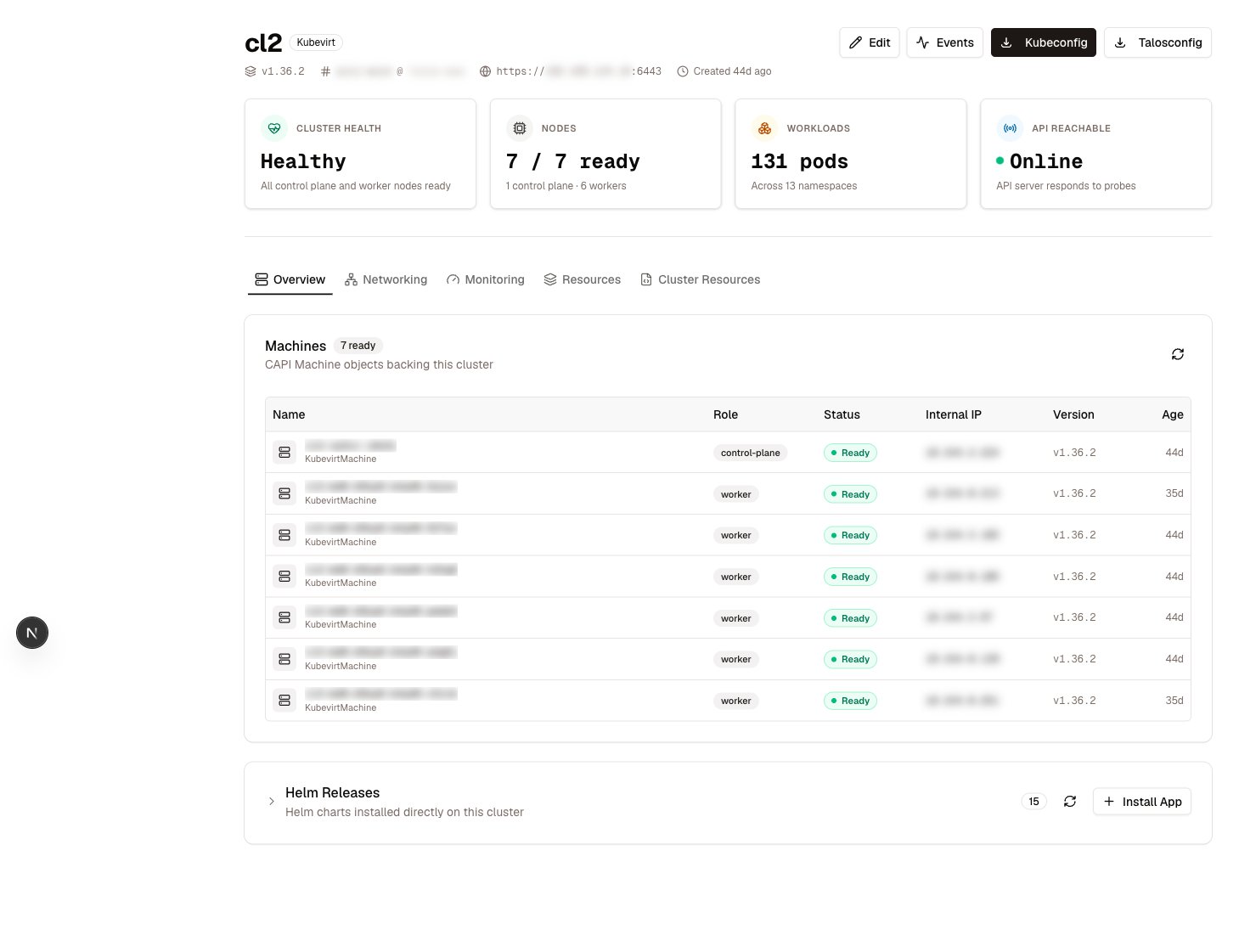
The primary model. A topology cluster is one declarative spec — Celum reads it back in the same shape for editing (GET /api/supervisors/<supervisor>/capi/clusters/<cluster>), updates it with PUT, and deletes it with a single DELETE that cascades through everything the Cluster CR owns:
addons block is what the CAAPH engine (below) acts on, and tenantLB wires the guest’s LoadBalancer Services into the supervisor’s IP pools. Clusters created inside a project land in that project’s namespace.
GitLab-managed guest clusters
The legacy model, still first-class where a supervisor has an attached GitOps repository: the cluster is a set of configuration files that Celum generates, previews, and commits (POST /api/clusters/preview, POST /api/clusters/create), then reconciliation on the supervisor builds the cluster. Updates and deletes are further commits (PUT /api/supervisors/<supervisor>/guest-clusters/<cluster>, DELETE /api/clusters/<cluster>/delete). The create page walks through both this flow and the topology flow.
Hosted control planes
When a tenant needs API-server isolation but not its own machines, a vcluster gives them a full Kubernetes control plane running as pods, sharing the supervisor’s nodes. Kamaji Talos workers go one step further: a hosted control plane plus real Talos worker VMs attached to it. Both are covered in Hosted control planes.The CAPI engine
Everything above depends on the engine Celum installs per supervisor during onboarding. It reports state through the standard component-status model and is managed with:GET /api/supervisors/<supervisor>/capi/status shows the operator release plus every provider — core, bootstrap, control plane (including Kamaji), and infrastructure:
HelmChartProxy objects per namespace. Its status endpoint reports the provider and each proxy’s readiness:
Which model when
1
A tenant needs a real cluster with its own nodes — topology cluster
The default. Declarative spec, direct apply, full edit/delete lifecycle, addons delivered automatically.
2
The supervisor's cluster inventory must live in Git — GitLab-managed
Choose this when review-by-merge-request and a versioned cluster definition are requirements. Requires an attached repository.
3
API-server isolation without dedicated machines — vcluster
Seconds to create, near-zero infrastructure cost, shares the supervisor’s nodes. Not suitable when the tenant needs its own kernel, CNI, or node-level configuration.
4
A hosted control plane with real worker nodes — Kamaji Talos workers
The control plane runs as supervisor pods, workers are Talos VMs. Good middle ground when control-plane VMs are the cost you want to avoid.
Permissions
The in-product assistant, Celum AI, answers cluster questions from these same APIs —
list_clusters, get_guest_cluster, and get_component_status (component capi or capi-addons) read the identical data these pages render.The Clusters pages
Create a cluster
The three creation flows — template wizard, standard form, ClusterClass form.
Templates & addons
Reusable blueprints with Go-template variables, and CRS addons pushed into guests.
Day-2 operations
Everything read inside a running tenant — nodes, events, metrics, Helm, workloads.
Hosted control planes
vcluster instances and Kamaji Talos workers.