
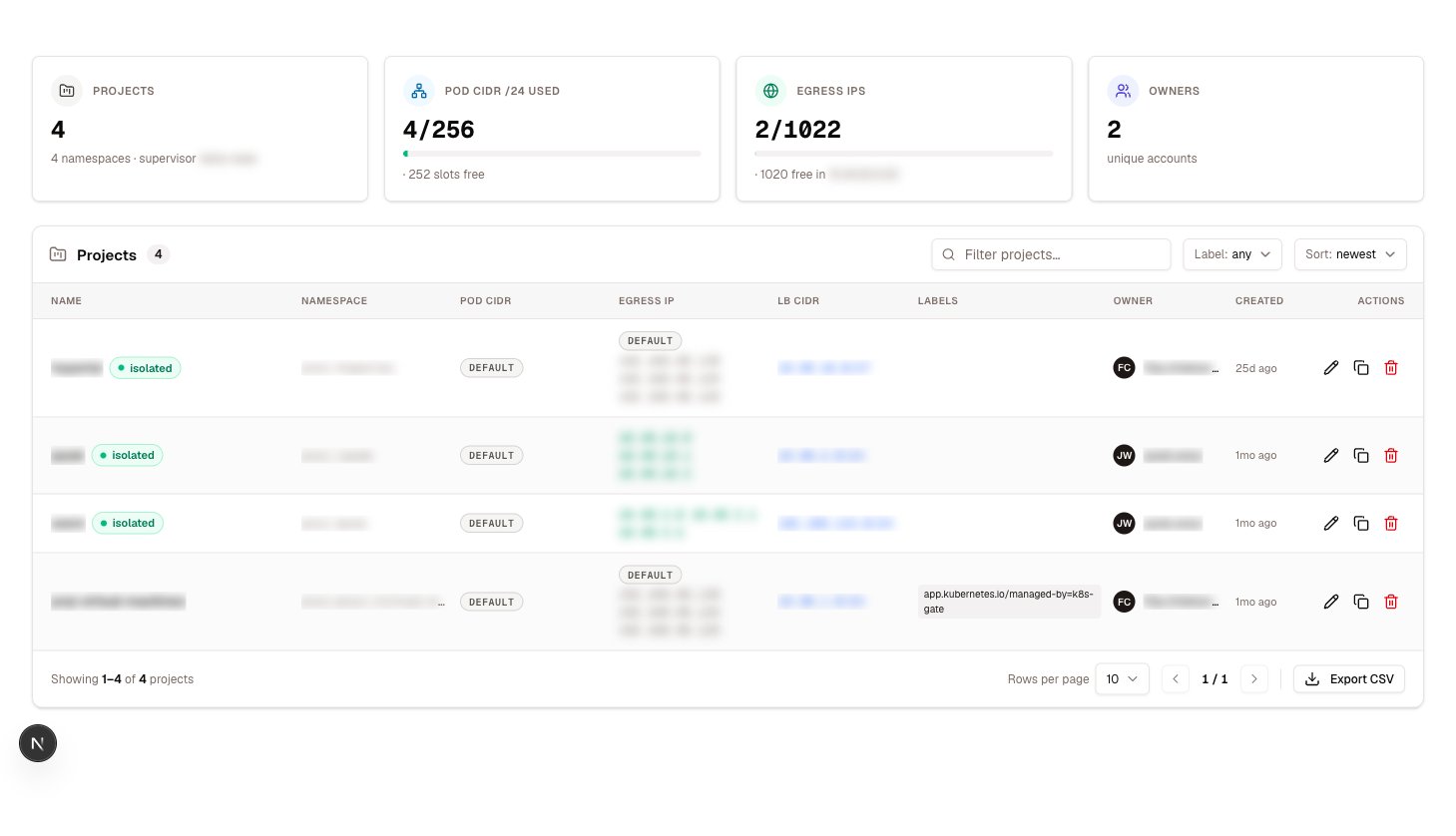
The Projects page — each project with its namespace, pod CIDR, egress addresses, LoadBalancer range, and isolation state.
What a project actually is
Celum stores no project state of its own. A project is Kubernetes objects, and Kubernetes is the only source of truth:
Description and creator are kept as namespace annotations (
nuvira.dev/description, nuvira.dev/created-by). Delete the namespace outside Celum and the project is gone — there is no database row left behind to reconcile.
Project names must be DNS-1123 labels: lowercase alphanumerics and hyphens, starting and ending with an alphanumeric, 2–42 characters. The namespace is always the name prefixed with
proj-.Supervisor pool configuration
Before projects can be allocated automatically, the supervisor needs to know which address space it is carving up. That configuration lives in a singletonNuviraClusterConfig CRD, plus the pod CIDR that Cilium already owns:
The config endpoint always answers, with a
seeded flag telling you which case you are in: true when the NuviraClusterConfig CRD exists, false when you are looking at derived defaults that nobody has confirmed.
Allocation
When you create a project you may specify the pod CIDR, LB CIDR, and egress IP, or leave them empty and let Celum allocate. Allocation works by listing the live Cilium CRDs on each create and taking the next free slice — there is no stored “taken” set that can drift from reality.Because allocation reads live state, a project created outside Celum that uses one of these ranges is still counted. Conversely, hand-editing a pool CRD changes what the allocator considers free.
Network isolation
New projects are isolated unless you opt out. Isolation is oneCiliumNetworkPolicy in the project namespace that flips it to default-deny and then opens a specific set of holes:
What the default isolation policy allows
What the default isolation policy allows
- Traffic within the project namespace, both directions
- Egress DNS to
kube-dnsinkube-system(UDP + TCP 53) - Ingress from the outside world, the host and remote nodes, and Cilium’s ingress proxy — which is what keeps kubelet probes and Gateway-published services working
- Ingress from the Cluster API and KubeVirt control-plane namespaces, so a guest cluster provisioned inside an isolated project can bootstrap
- Egress to the world, host and remote nodes, and the Kubernetes API server
- Egress to the central observability stack, unless you turn that off
What it denies
What it denies
Ingress from every other namespace on the supervisor. That is the point of the policy — everything else in the list above exists to stop the deny from breaking things that must keep working.
Create-once, never overwritten
The isolation policy is created only when it is absent. Re-applying a project never overwrites it, so exceptions you add in Policy Studio survive. Turning the toggle off deletes the policy. This is why the UI tracks intent and reality separately: the namespace annotation records that the project should be isolated, while the badge reads whether the policy currently exists. A policy deleted by hand in Policy Studio shows the project as open even though its annotation still says isolated.Two related switches
Egress
Each project can leave the cluster with its own source IP, which is what makes project-level firewall rules possible upstream.The project form also offers an anycast egress routing choice. Selecting it records the intent on the project, but the data plane still performs single-active failover — it does not yet change how traffic is routed.
VM identity pool
A project may additionally be given a VM-identity CIDR (between/16 and /29). Each VM in the project then claims a routable address that follows it through live migration, with no LoadBalancer involved.
BGP advertisement
A project’s three address sources — pod, LoadBalancer, and egress — each carry an advertise choice of default, on, or off. The selection is stored on the namespace and fanned out to the BGP configuration, so what the fabric hears matches what the project declared.Deleting a project
Deletion is an ordered teardown, not a namespace delete: Cluster API clusters in the project go first, the namespace last. While it runs, the project reports itself as deleting.Permissions
Projects are gated by the Cilium actions, not by aproject:* service — a project is Cilium configuration, and the permission model follows the objects rather than the UI page.
What commonly goes wrong
Related
Supervisors & clusters
The layer a project sits on.
Permissions model
Why project routes resolve to
cilium:* actions.Create a cluster
Clusters are provisioned into a project’s namespace.
Glossary
Supercidr, EGP, KRN, and the rest of the vocabulary.